


The Ultimate Guide to Starting a Financial Brokerage from Home
In an era where capital is the lifeblood of innovation and personal stability, there is one business that remains eternally relevant: Money Finding. Whether it is a small business looking to expand or an individual seeking a personal loan, the demand for capital never sleeps.
As a Financial Broker, you act as the vital bridge between those who have capital (lenders) and those who need it (borrowers). Here is how you can turn this "needed money business" into a lucrative home-based career.
Prefer watching over reading? Click play below.
What Exactly is a Financial Brokerage?
At its core, a financial brokerage is a service-based business where you find loans for people and businesses in exchange for a fee. You are essentially a matchmaker for money.
The Fee Structure
One of the most attractive aspects of this business is the high earning potential per transaction. According to the industry standard outlined in the text:
The First Million: Your fee typically starts at 5% of the loan amount. For a $1,000,000 loan, that is a $50,000 commission.
Subsequent Millions: For amounts exceeding the first million, the fee typically declines by 1% for each additional million.
Protecting Your Interests
Because you are dealing with large sums of money, documentation is your best friend.
Written Agreements: Never start work without a signed agreement between yourself and the borrower. This must specify the fee amount, when it will be paid, and the conditions of payment (usually when the borrower receives the funds).
"Brokers Protected": When scouting for lenders, look for those who state "Brokers Protected." This means the lender acknowledges your role and will pay your fee directly upon the closing of the loan.

Operating Ethically:
The Golden Rule of Fees
The text offers a stern warning regarding "front-money." In the brokerage world, your reputation is your currency.
Avoid Advance Fees: You must not charge thousands of dollars in "upfront" or "front-money" fees. This practice often leads to legal investigations and disgruntled clients, especially if a loan isn't secured.
Nominal Expenses: It is permissible to charge a small, nominal fee to cover out-of-pocket expenses (like digital subscriptions, long-distance communication, or document processing), but this should always be backed by a written agreement.
Pro Tip: If you focus on getting the deal closed rather than collecting small upfront fees, the large commissions at the end will take care of themselves.
How to Get Started:
The Essentials
Starting a financial brokerage is surprisingly low-cost. While the original text suggests a budget of $350 to $500, even in today’s economy, the "barrier to entry" remains primarily your ability to network and market.
Equipment Checklist
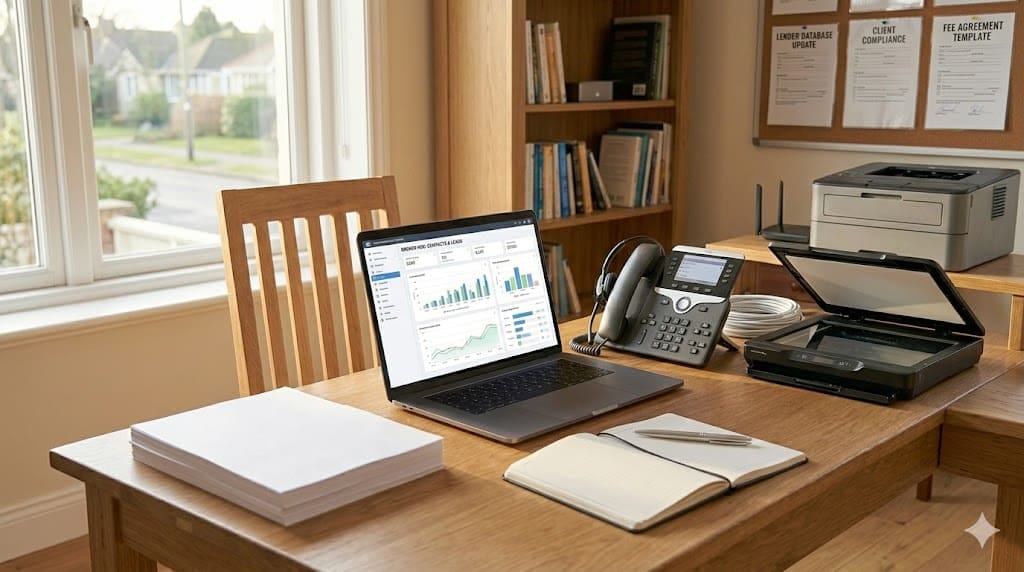
You don't need a high-rise office to move millions of dollars. Your home setup should include:
A Dedicated Workspace: A professional desk environment.
Reliable Communication: A smartphone and high-speed internet are non-negotiable.
Record Keeping: A PC or laptop for tracking leads, managing lender databases, and accessing financial portals.
Legal Support: In some jurisdictions, a license may be required. The text suggests partnering with a local attorney who specializes in finance to ensure you are compliant with local laws.
Finding Your First Clients
Marketing has evolved, but the principles remain the same. You can find leads through:
Digital Advertising: Google Ads and LinkedIn are the modern equivalents of the "classifieds."
Niche Publications: Advertising in business journals or local trade magazines.
Networking: Joining local business chambers where entrepreneurs often seek expansion capital.
Earnings and Growth Potential
The earnings potential for a home-based financial broker is significant, often ranging from $50,000 to over $100,000 annually. The ceiling is determined entirely by two factors:
1. Willing Lenders: Building a rolodex of reliable banks, private investors, and alternative lenders.
2. Qualified Borrowers: Learning how to vet clients so you only present "fundable" deals to your lenders.
Idea Filter: Lab Test Result
Evaluating the Financial Brokerage Business Model
Criteria
Result
Analysis
Market Demand
High
The DIY and "handmade" movement is growing at a 5-7% CAGR. It thrives in both good and bad economies.
Startup Cost
Low
You can launch your first "Line" for under $600. No warehouse, no massive inventory.
Scalability
Extreme
Since the product is digital (PDF/SVG), your cost of goods sold (COGS) is essentially $0 after the first sale.
Risk Level
Low
If a design doesn't sell, you've only lost a few hours of time, not thousands of dollars in stock.
Time to Revenue
Medium
You need roughly 8–12 weeks to build "algorithm authority" on platforms like Pinterest or Etsy.
Final Verdict: This is an "A-Tier" home business for those with strong communication skills and a knack for networking.
Conclusion
The "Money Finding" business is a classic for a reason: it solves the most fundamental problem in capitalism—the movement of capital. By positioning yourself as the expert who knows where the money is, you create a service that is always in demand, regardless of the economic climate.
Frequently Asked Questions
Varies by state/country, usually requires a simple registration or partnership with an attorney.
$50k - $100k annually depending on deal flow.

Gom is a home business entrepreneur dedicated to hunting for the best income ideas so you don't have to. With experience in network marketing since 2001, he focuses on high-leverage strategies for the modern digital economy.


Trending